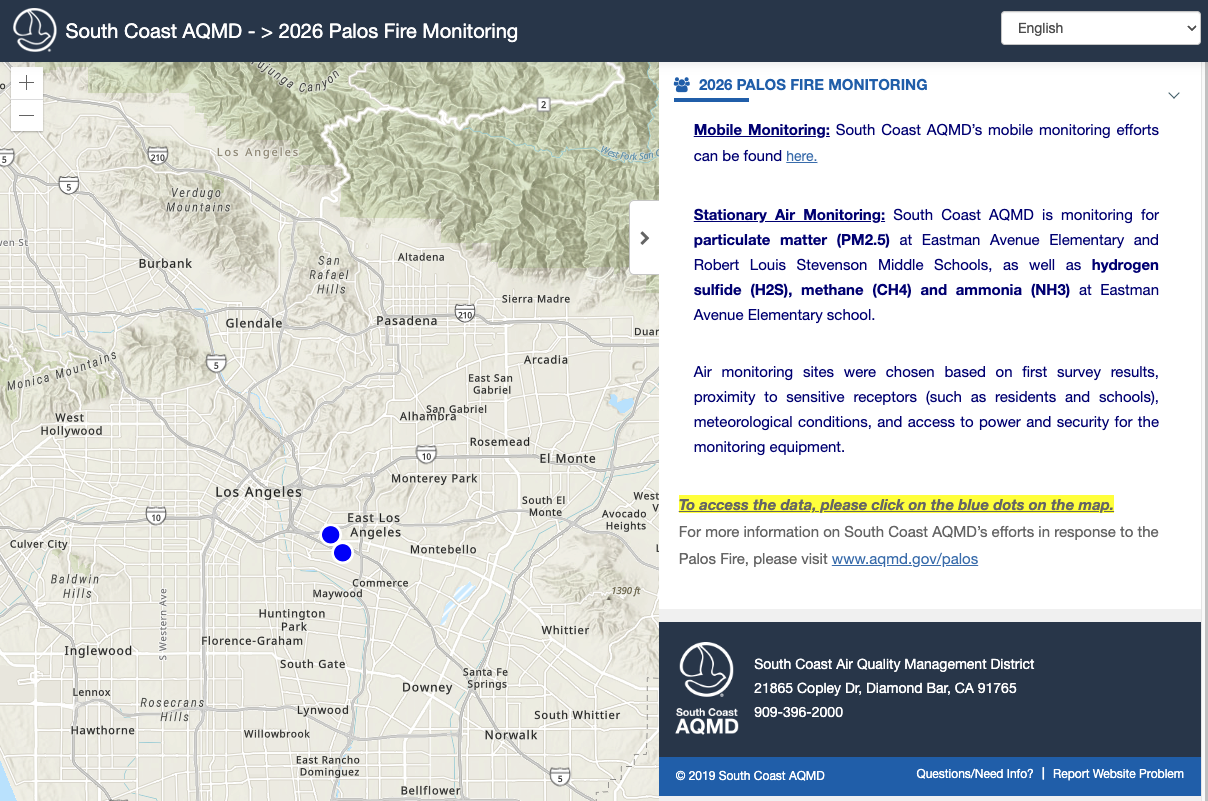
South Coast AQMD deployed two particulate matter (PM2.5) continuous monitors on June 19th. A continuous hydrogen sulfide (H2S) and methane (CH4) monitor was added at Eastman Ave Elementary School on July 9th followed by a continuous ammonia (NH3) monitor on July 23rd. Air monitoring sites were chosen based on the mobile monitoring survey results identifying the most impacted areas, proximity to sensitive receptors (such as residents and schools), meteorological conditions, and access to power and security for the monitoring equipment.
South Coast AQMD deployed PM2.5 monitors at Eastman Avenue Elementary and Robert Louis Stevenson Middle School, and fed that data, along with our regionally placed air monitors and hundreds of local sensors, into our Air Quality Index (AQI) map to provide localized information via our South Coast AQMD mobile app or at www.aqmd.gov.
Data Reporting
- Eastman Ave Elementary and Stevenson Middle schools: Continuous PM2.5 monitoring is being conducted at these two sites, as well as continuous hydrogen sulfide (H2S), methane (CH4) and Ammonia (NH3) at Eastman Ave Elementary school. Data is reported hourly and provides near-real-time concentration levels. To view data from these sites, click on the map below to be transferred to the data dashboard.
- Data from our regional air monitors can be found here.
Please note:
9/22/2026:Air monitoring data for fine particulate matter (PM2.5) at the Eastman Ave Elementary School monitoring station was unavailable from 4 AM and 12 PM local time (Pacific Daylight Time (PDT)) on 9/22/2026 due to an issue that was resolved after troubleshooting. All monitors resumed normal operations starting at 12 PM PDT.
Air monitoring data for gaseous pollutants (hydrogen sulfide (H₂S), methane (CH₄), and ammonia (NH₃)) at the Eastman Ave Elementary School monitoring station were unavailable from 11 AM and 12 PM local time (Pacific Daylight Time (PDT)) on 9/2/2026 due to routine maintenance and quality control to ensure data accuracy. All monitors resumed normal operations starting at 1 PM PDT.
9/11/2026: Air monitoring data for ammonia (NH₃) at the Eastman Ave Elementary School monitoring station were unavailable from 3-5 PM local time (Pacific Daylight Time (PDT)) on 9/11/2026 due to routine maintenance and quality control to ensure data accuracy. All monitors resumed normal operations starting at 6 PM PDT.
South Coast AQMD staff replaced the internal pump on September 7 and restored the instrument to normal operation. Valid ammonia monitoring data resumed at 4:00 PM PST on September 7, 2026.
9/9/2026: Air monitoring data for gaseous pollutants (hydrogen sulfide (H₂S), methane (CH₄), and ammonia (NH₃)) at the Eastman Ave Elementary School monitoring station were unavailable from 11 AM and 12 PM local time (Pacific Daylight Time (PDT)) on 9/9/2026 due to routine maintenance and quality control to ensure data accuracy. All monitors resumed normal operations starting at 1 PM PDT.
9/4/2026 – 9/7/2026: Ammonia (NH₃) monitoring data from the Eastman Avenue Elementary School air monitoring station are invalid from 12:00 AM local time (Pacific Daylight Time (PDT)) on September 5 through 3:00 PM PDT on September 7 due to an internal pump failure. Although the instrument continued to report values during this period, the data were determined to be invalid upon review and have been removed. South Coast AQMD staff replaced the internal pump on September 7 and restored the instrument to normal operation. Valid ammonia monitoring data resumed at 4:00 PM PDT on September 7, 2026.
Contractor Data & Oversight
South Coast AQMD is providing active technical oversight of the third-party contractor, who is conducting community air monitoring during the cleanup phase. South Coast AQMD is working closely with LA DPH, OEHHA, and CARB to:
- Ensure the monitoring is scientifically sound & responsive to community concerns;
- Review the community air monitoring plan for appropriate pollutants to measure;
- Review and providing feedback on air monitoring locations, methodologies, procedures, data analysis, and reporting; and
- Ensure monitoring is conducted where and when it is most needed to accurately characterize pollutants in the surrounding neighborhood.
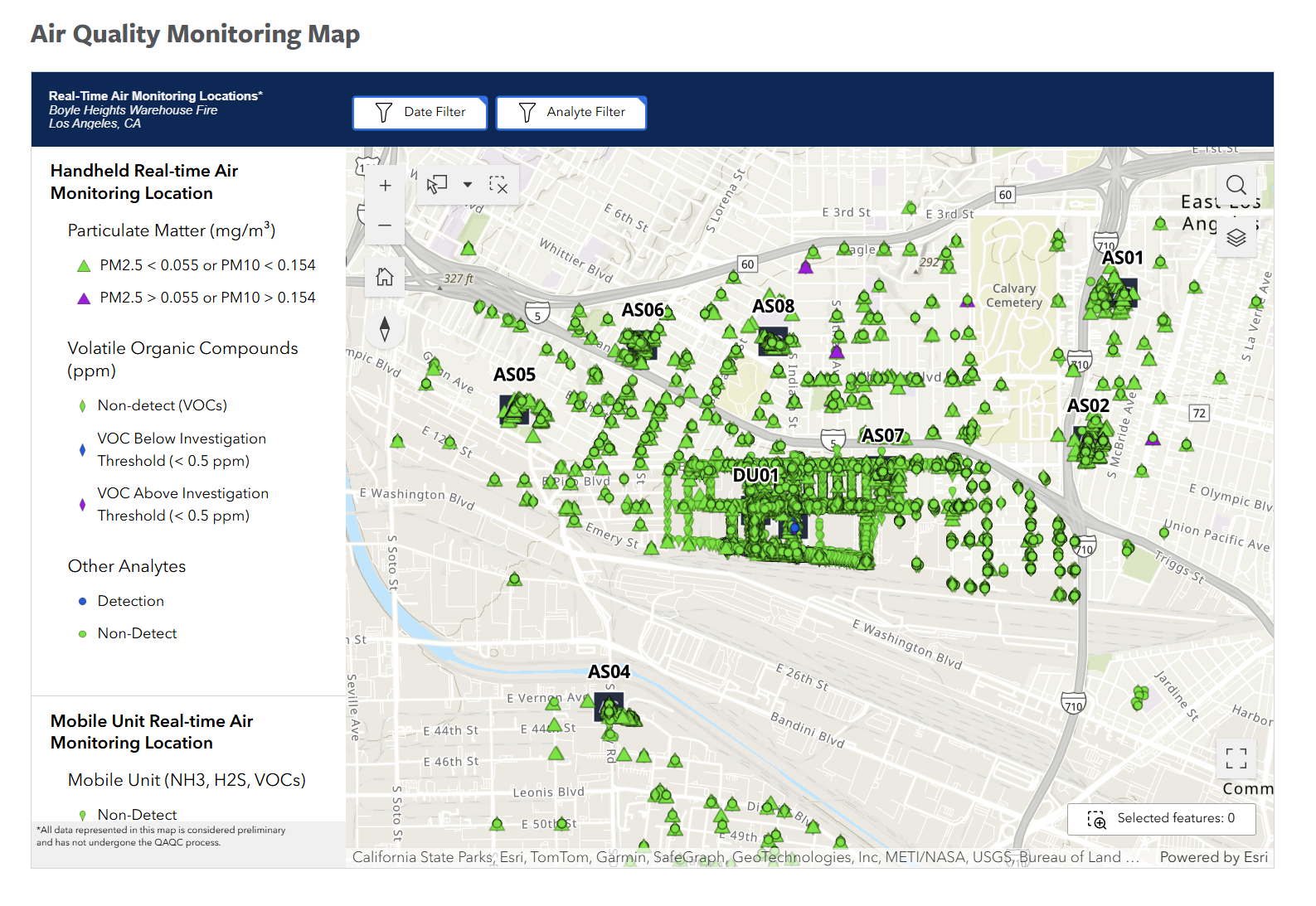
In addition, South Coast AQMD is advocating for the contractor to provide its monitoring data to the public in a timely manner, so community members have access to the information as it becomes available. To view data from these sites, click on the map below to be transferred to the data dashboard.
South Coast AQMD Independent Air Quality Assessments
To provide an additional layer of independent oversight, South Coast AQMD is also conducting its own unannounced air quality assessments throughout the community. These independent measurements will be compared with the contractor's monitoring results to help validate the findings and provide additional confidence in the data. Some of the pollutants measured can be found here.
The human nose can detect some odors at concentrations well below levels associated with long-term heath concerns, and, in some cases, below the levels detectable by air monitoring equipment. However, odors may cause temporary symptoms such as headache, nausea, or eye, nose, and throat irritation in some people.
Ammonia Measurements (August 21st)
- South Coast AQMD conducted unannounced monitoring for ammonia (NH3) in the community around the facility.
- Measurements were made at 4 locations (Figure 36) for about 25 minutes at each location
- The highest ammonia levels were measured at the intersection of South Indiana and Union Pacific (Figure 37):
- The maximum instantaneous concentration measured at this location was 88.23 ppb.
- Levels measured at Los Palos and Union Pacific as well as South Indiana and Noakes were slightly elevated:
- The maximum instantaneous concentration measured at Los Palos and Union Pacific was 104.08 ppb.
- The maximum instantaneous concentration measured at Los Palos and Union Pacific was 41.46 ppb.
- The maximum instantaneous concentration measured at South Indiana and Noakes was 42.19 ppb.
- These levels are well below OEHHA’s acute Reference Exposure Level (REL) for ammonia, which is 4,600 ppb averaged over one hour.
- Levels measured at Eastman Avenue Elementary School were generally consistent with the typical ambient background levels during oversight air monitoring. Background levels in Los Angeles range from 0-36 ppb.
Ammonia Measurements (August 7th)
- South Coast AQMD conducted unannounced monitoring for ammonia (NH3) in the community around the facility.
- Measurements were made at 4 locations (Figure 34) for 25 minutes at each location
- The highest ammonia levels were measured at the intersection of South Indiana and Union Pacific (Figure 35):
- The maximum instantaneous concentration measured at this location was 164.02 ppb.
- Levels measured at Los Palos and Union Pacific as well as South Indiana and Noakes were also elevated:
- The maximum instantaneous concentration measured at Los Palos and Union Pacific was 104.08 ppb.
- The maximum instantaneous concentration measured at South Indiana and Noakes was 35.7 ppb.
- These levels are well below OEHHA’s acute Reference Exposure Level (REL) for ammonia, which is 4,600 ppb averaged over one hour.
- Levels measured at Eastman Avenue Elementary School were generally consistent with the typical ambient background levels during oversight air monitoring. Background levels in Los Angeles range from 0-36 ppb.
July 30th Mobile Monitoring
- South Coast AQMD conducted unannounced monitoring near the facility and in downwind communities.
- Most VOCs, including measured air toxics such as benzene, were observed at levels consistent with past mobile monitoring in this area and were largely influenced by vehicular emissions. (Figure 30)
- Elevated levels of odorous compounds were observed at multiple locations next to and downwind of the facility.
- These can be detected by the human nose at very low levels and include compounds such as methyl mercaptan, which has a strong, unpleasant odor similar to rotten cabbage or rotten eggs. Most other odorous compounds have a similar distribution pattern to methyl mercaptan. (Figure 31)
- Dimethyl disulfide, which has a strong, garlic-like odor, has typically had the same distribution pattern as methyl mercaptan but was elevated along Los Palos on July 30th. (Figure 32)
- While concentrations of this compound sometimes exceeded background levels, the levels were well below available health-based exposure limits.
- Methane levels were within typical ranges, except for one location at the intersection of S. Sunol Dr. and Durham St., possibly from gas leaks (Figure 33), were detected. These results were reported to utilities for further investigation.
Ammonia Measurements (July 28th)
- South Coast AQMD conducted unannounced monitoring for ammonia (NH3) in the community downwind of the facility.
- Measurements were taken at 4 locations (Figure 28) for 20 minutes to more than an hour at each location.
- The highest ammonia levels were measured at the intersection of Union Pacific Ave and S Indiana St (Figure 29):
- The maximum instantaneous concentration measured at this location was 568.79 ppb.
- Levels measured at Union Pacific Ave and Prado St as well as Union Pacific Ave and Alma Ave were also elevated:
- The maximum instantaneous concentration measured at Union Pacific and Prado St was 376.83 ppb.
- The maximum instantaneous concentration measured at Union Pacific and Alma Ave was 137.53 ppb.
- These levels are well below OEHHA’s acute Reference Exposure Level (REL) for ammonia, which is 4,600 ppb averaged over one hour.
- Levels measured at Eastman Avenue Elementary School were generally consistent with the typical background levels.
Ammonia Measurements (July 15th and 16th)
- South Coast AQMD conducted unannounced monitoring for ammonia (NH3) in the community downwind of the facility.
- Measurements were taken at 6 locations (Figure 26) for 30 minutes to more than an hour at each location.
- The highest ammonia levels were measured at the intersection of Union Pacific and Alma Ave on both days:
- The maximum instantaneous concentration measured at this location was 267.51 ppb on 7/15 and 76.67 ppb on 7/16. (Figure 27)
- These levels are well below the states short-term exposure levels of 4,600 ppb averaged over one hour.
- Other monitored locations showed ammonia levels within typical background levels.
July 14th Mobile Monitoring
- Most VOCs, including measured air toxics such as benzene, were observed at levels consistent with past mobile monitoring in this area and were largely influenced by vehicular emissions. (Figure 23)
- Elevated levels of odorous compounds were observed at multiple locations downwind of the facility.
- These compounds can be detected by the human nose at very low levels and include VOCs such as methyl mercaptan, which has a strong, unpleasant odor similar to rotten cabbage or rotten eggs. While concentrations of this compound sometimes exceeded background levels, the levels were well below available health-based exposure limits. (Figure 24)
- Methane levels were within typical ranges, except for one location at the intersection of Whittier Blvd. and S. Downey Blvd, possibly from gas leaks (Figure 25), were detected. These results were reported to utilities for further investigation.
June 29th Mobile Monitoring
- Most VOCs, including measured air toxics such as benzene, were observed at levels consistent with past mobile monitoring in this area and were largely influenced by vehicular emissions. (Figure 20)
- Elevated levels of odorous compounds were observed at multiple locations downwind of the facility.
- These compounds can be detected by the human nose at very low levels and include VOCs such as methyl mercaptan, which has a strong, unpleasant odor similar to rotten cabbage or rotten eggs. While concentrations of these compounds sometimes exceeded background levels, they are well below available health-based exposure limits. (Figure 21)
- Methane levels were within typical ranges. (Figure 22)
Palos Fire Mobile Monitoring
Mobile monitoring surveys measured for particulate matter and toxic metals (6/17 & 6/18) as well as Hydrogen Fluoride (HF) (6/18) during the active fire. Please note, these surveys capture a snapshot (less than 5 minutes).
Mobile surveys do not sample for a long enough time period at any location to establish risks to human health. They are used to identify potential hot spots and help guide where stationary monitoring sites may be needed.
June 18th Mobile Monitoring
- Significantly elevated concentrations of particulate matter (PM2.5) were observed for a few seconds at a time within the plume downwind of the fire. (Figures 10 and 11)
- No measurable levels of HF were seen. (Figure 12)
- Air toxic metals levels were within typical ranges. (Figures 13-17)
- Increased levels of bromine and chlorine were observed. Bromine and chlorine are typically found at trace levels during structural fires and the levels seen were below short-term health-based exposure thresholds. (Figures 18 and 19)
June 17th Mobile Monitoring
- Significantly elevated concentrations of particulate matter (PM2.5) were observed for a few seconds at a time within the plume downwind of the fire. (Figures 1 and 2)
- Air toxic metals levels were within typical ranges. (Figures 3-7)
- Increased levels of bromine and chlorine were observed. Bromine and chlorine are typically found at trace levels during structural fires and the levels seen were below short-term health-based exposure thresholds. (Figures 8 and 9)
Cleanup Progress
On August 29, South Coast AQMD confirmed that Lineage had completed removal of all bulk food waste from Freezer 1. With all bulk food waste removed, the 7-day clock has started for Lineage to complete final clean-up activities include complete debris removal, power washing, and disinfecting of Freezer 1 by September 5, 2026. Negative air pressure must be maintained inside the building during this work, and air pollution control equipment must continue to operate.
South Coast AQMD will continue conducting facility inspections and air monitoring to verify compliance with applicable requirements and the Order for Abatement.
Order for Abatement
On July 17th, South Coast AQMD issued a demand letter requiring Lineage Logistics, LLC., to strengthen its Odor Management Plan by incorporating additional measures. That letter can be found here.
Following South Coast AQMD sending its demand letter to Lineage, the District filed a Petition for an Order for Abatement before the independent South Coast AQMD Hearing Board. That proceeding was held on August 5–6, 2026, to hear proposed conditions to reduce odors impacting the nearby community from the Lineage Warehouse fire cleanup. The final Order for Abatement is available here. Case documents for the Hearing Board can be found here.
Violations
South Coast AQMD Rule 402 and California Health & Safety Code Section 41700 prohibit emissions that cause injury, nuisance, or annoyance to a significant number of people or the public. When public odors complaints are received, inspectors respond. If Inspectors confirm the odors with community members and trace them back to cleanup operations at the facility, a violation can be issued. See below for recent violations of public nuisance rules issued to Lineage Logistics, LLC.
Rule 402 Public Nuisance Violations |
Date of Violation |
July 12, 2026 |
July 13, 2026 |
July 14, 2026 |
July 15, 2026 |
July 16, 2026 |
July 17, 2026 |
July 18, 2026 |
July 19, 2026 |
July 20, 2026 |
July 21, 2026 |
July 22, 2026 |
July 23, 2026 |
July 24, 2026 |
July 25, 2026 |
July 26, 2026 |
July 27, 2026 |
July 28, 2026 |
July 29, 2026 |
July 30, 2026 |
July 31, 2026 |
August 1, 2026 |
August 2, 2026 |
August 3, 2026 |
August 4, 2026 |
August 5, 2026 |
August 7, 2026 |
August 8, 2026 |
August 12, 2026 |
August 13, 2026 |
August 14, 2026 |
August 15, 2026 |
August 16, 2026 |
August 17, 2026 |
August 19, 2026 |
August 20, 2026 |
August 22, 2026 |
August 23, 2026 |
August 25, 2026 |
August 28, 2026 |
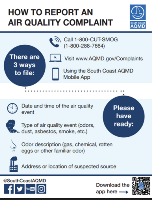
We understand that odors will likely be an ongoing issue throughout the cleanup. Local residents may report odors, smoke, and other air quality issues to South Coast AQMD by calling 1-800-CUT-SMOG (288-7664), via our online complaint portal at www.aqmd.gov/complaints, or through our mobile app. South Coast AQMD responds to all air quality complaints received from the public. Agency partners are working with the facility to assist with identifying odor mitigation measures to minimize impacts to Boyle Heights and the surrounding communities.
Residential Air Purifiers
In response to the ongoing impacts of the 2026 Palos Fire in Boyle Heights South Coast AQMD has approved up to $5 million in additional funding to provide residential air purifiers to local residents as quickly as possible.
The funding will expand South Coast AQMD’s AB 617 Residential Air Filtration Incentives. This program will help households in Boyle Heights and surrounding communities reduce exposure to harmful air pollutants during fire cleanup activities.
The program provides eligible residents with:
- High-Efficiency Particulate Air (HEPA) purifier(s) that remove 99.97% of particles from indoor air, effectively filter smoke and dust particles and are ENERGY STAR certified.
- Three-year supply of replacement filters.
- All items will be shipped directly to applicant at no cost. South Coast AQMD is working with multiple vendors to expedite delivery and distribution process.
The program is available to residents in the East Los Angeles, Boyle Heights, and West Commerce (ELABHWC) community and will continue on a first-come, first-served basis until funds are exhausted.
More information, including eligibility as well as online applications, can be found at the Residential Air Filtration Incentives webpage.
City, County, state, and community partners are working together to ensure residents have access to timely information, available resources, and support throughout the response and recovery process. View latest updates here.
The Los Angeles Department of Public Health has also shared information on What You Should Know About Air Purifiers and Environmental Odors: What You Should Know.